Showing posts with label Sourdough. Show all posts
Saturday, April 28, 2012
Austin lives! (part 2)
After a couple of weeks of twice-a-day feedings and doublings, I decided that Austin was ready for a real test-drive.
I've used discards from his feedings in our pretzel dogs and in my almost-no-knead bread, and this morning I used a cup of discarded starter to make KAF's sourdough crumpets for breakfast. I've never had crumpets before, and I wish I'd read Celia's crumpet post first because mine definitely didn't have the holes that she talks about. Still, they were easy and tasty, and a fun way to use starter discard.
So, on to our first real test-drive: I decided to try the basic pure sourdough (not spiked with instant yeast) from Peter Reinhart's ABED. The dough was gorgeous.
Unlike my first (fairly unsuccessful) tries with pure sourdough, I ignored the timings from the recipe and just let it rise for a really long time. It came out of the fridge at 6:00 a.m. I didn't shape it until about 10:00 a.m. and didn't bake it until about 4:30 p.m. (our house was quite cool). Even after all that time, you can see that I still had quite a bit of oven spring.
This bread was great: it had a subtle flavor, a fairly open crumb, a crunchy but not tough crust. And best of all, it was made with 100% pure Austin! =)
Friday, April 27, 2012
At long last: Almost no-knead bread
I've been reading about no-knead bread for a few years, but as someone who was so enamored with all the intricacies of bread baking that she read the first 100 pages of The Bread Baker's Apprentice like a novel not once, but twice, I wasn't that excited by the idea of a bread that essentially makes itself.
But here we are, a couple of years and two bread book challenges later, and sometimes life is just busy: I needed a bread I could make in a flash to go with our cauliflower soup. Happily, browsing my friends' Pinterest bread collections (yes, I've finally been sucked into that time black hole), I found a link to America's Test Kitchen's newest version of their almost no-knead bread, a recipe I've been meaning to make for so long but that always gets lost in the stack of new recipes.
I made a half-recipe, mixing up the all-purpose flour, salt, a pinch of yeast, water, and a bit of beer. The last ingredient is vinegar, but I'd read that the purpose of the vinegar is to give it a hint of sourdough flavor, so I used my discard from a sourdough feed instead. The ingredients are barely mixed and then left at room temperature for 16ish hours. After school, I rushed home and shaped my little boule and left it in a warm spot in my 6" cake pan. Once it had risen, I baked it in my new small enameled Dutch oven for 25 minutes uncovered and about 10 or 15 minutes uncovered.
The bread was perfect with the soup; in fact (surprisingly) hubby said it was the best bread I'd made in a long time. Who knew?! (Oh, and there was definite hint of sourdough flavor in there: from the sourdough starter? I don't know, but I think Austin is finally ready for a test drive this weekend!!)
Monday, April 23, 2012
Austin lives! Resuscitating a sourdough starter
I first made my sourdough starter in the midst of the Bread Baker's Apprentice Challenge, in February of 2010. It was slow-going, which I took personally, but as the warmer weather hit in June, I realized that my starter's slow nature was likely due to our cool house and frigid winter. Austin the Starter has served me well over the past two years.
Since I've been finished with my bread challenges, Austin spends most of his time in the back of my fridge. He's endured many long periods of neglect, but always does fine when I pull him out and give him a few feedings. So imagine my surprise when I pulled him from the fridge a few days ago, and, whether it was because he'd finally been ignored for too long or because the new lid I put on top was too tight, this is what I found:
Mold!!! I'm not going to lie; I almost cried. Austin has been a reliable member of my kitchen staff for so long, and it's such a process to create a sourdough starter...and the longer they're around, the better their flavor, so I really didn't want to start over. :(
And then I remembered that two summers ago, when we were heading West for our summer trip, I followed Paul's advice and dried some of my starter. I frantically started digging through my freezer. No starter. :( (I did get my freezer reorganized in the process of my search, so that was good.) I dug through the deep freeze; no starter. I came back upstairs, again on the verge of tears. And there, in the bottom of the ice bucket, I found this:
Yay! So I pulled up Paul's tutorial on how to revive a dried starter and got to work. I took a teaspoon of starter (saving the rest, just in case it didn't work or this happens again!) and mixed it with a couple of teaspoons of water. I let them sit for a few hours until the starter softened and I could stir it all together. Then I fed it some flour and water and crossed my fingers.
After a day, I detected a few bubbles. I think at that point, I should have just fed it again and waited a bit, but I was too excited, so I called it good and did an official feeding: 20 g of the starter with 40 g each of flour and water. And then I waited and waited and waited. I'd been thinking that I might need to start over and try again, when I came downstairs to this:
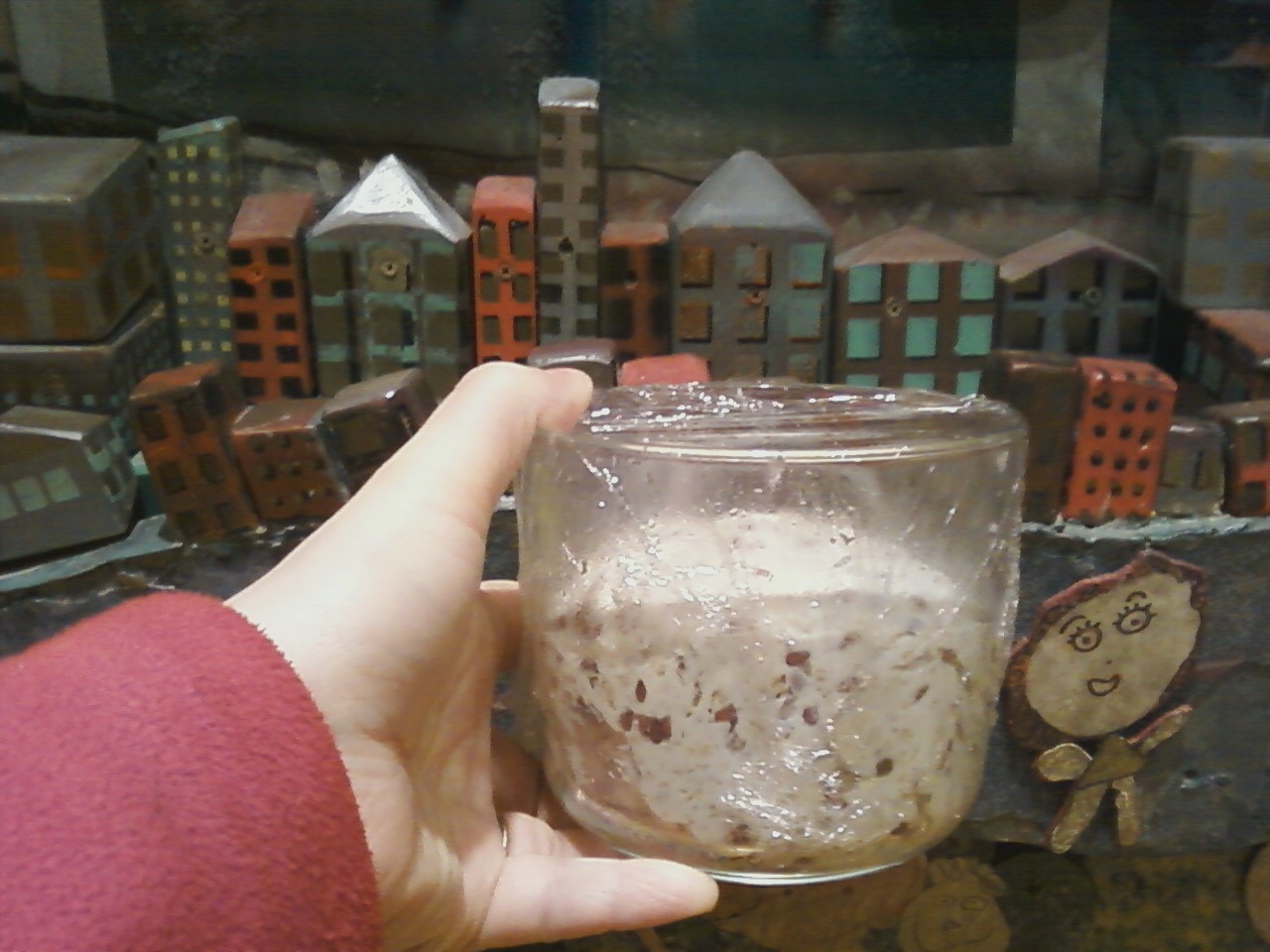
I'm not sure if I got ahead of myself and tried to move it along too fast, or if it was just that our house has been a little cool, but it took a good day for it to double. But double it clearly did! I've been feeding it regularly for two days now, and after each feeding, it takes less time to double again. And it already smells deliciously like sourdough.
My plan is to keep it on the counter and to keep feeding it regularly for another few days to make sure it's really awake, alive, and healthy. And then I'll try baking with it to make sure. But thankfully, we seem to be back in business! Austin lives!
(Thanks, Paul!)
Since I've been finished with my bread challenges, Austin spends most of his time in the back of my fridge. He's endured many long periods of neglect, but always does fine when I pull him out and give him a few feedings. So imagine my surprise when I pulled him from the fridge a few days ago, and, whether it was because he'd finally been ignored for too long or because the new lid I put on top was too tight, this is what I found:
Mold!!! I'm not going to lie; I almost cried. Austin has been a reliable member of my kitchen staff for so long, and it's such a process to create a sourdough starter...and the longer they're around, the better their flavor, so I really didn't want to start over. :(
And then I remembered that two summers ago, when we were heading West for our summer trip, I followed Paul's advice and dried some of my starter. I frantically started digging through my freezer. No starter. :( (I did get my freezer reorganized in the process of my search, so that was good.) I dug through the deep freeze; no starter. I came back upstairs, again on the verge of tears. And there, in the bottom of the ice bucket, I found this:
Yay! So I pulled up Paul's tutorial on how to revive a dried starter and got to work. I took a teaspoon of starter (saving the rest, just in case it didn't work or this happens again!) and mixed it with a couple of teaspoons of water. I let them sit for a few hours until the starter softened and I could stir it all together. Then I fed it some flour and water and crossed my fingers.
After a day, I detected a few bubbles. I think at that point, I should have just fed it again and waited a bit, but I was too excited, so I called it good and did an official feeding: 20 g of the starter with 40 g each of flour and water. And then I waited and waited and waited. I'd been thinking that I might need to start over and try again, when I came downstairs to this:
I'm not sure if I got ahead of myself and tried to move it along too fast, or if it was just that our house has been a little cool, but it took a good day for it to double. But double it clearly did! I've been feeding it regularly for two days now, and after each feeding, it takes less time to double again. And it already smells deliciously like sourdough.
My plan is to keep it on the counter and to keep feeding it regularly for another few days to make sure it's really awake, alive, and healthy. And then I'll try baking with it to make sure. But thankfully, we seem to be back in business! Austin lives!
(Thanks, Paul!)
Friday, January 6, 2012
Sourdough seed rye: Mellow Bakers finale
Well here we are at the end! (again) When I was nearing the end of the BBA Challenge and wondering, "What in the heck am I going to do without a new bread to bake every week?!" Paul suggested a Mellow group...a group of bakers who would spend two years baking through Jeffrey Hamelman's amazing book Bread. Even though I wasn't quite finished with the BBA, I happily jumped on board.
And here we are...94 weeks and 64 breads later.
I've thoroughly enjoyed participating on the ever-helpful Mellow Bakers forum and meeting so many wonderful bread bakers. And of course trying so many new bread formulas and techniques. I feel like the BBA introduced me to bread baking and taught me so many basics. Baking through Bread turned me into a bread baker. My confidence has improved a ton, as well as my knowledge, and not many recipes intimidate me anymore.
My top recipes from the book (all of which have been made repeatedly) are:
There is some talk on the forum about choosing a new book and starting a new challenge. At this point, I think I will probably purchase whichever book is picked so that I can bake along occasionally, but I will not plan to bake my way through another bread book. My family is really excited about the possibility of getting to pick their past favorites and have me actually be willing to bake them again because I'm not so worried about finishing breads for a challenge! :) And I'm excited to be able to bake things that look/sound good from various sources.
So the last bread I baked was actually a December bread that I missed with all of the holiday baking last month. Having just made the roasted garlic (which hubby says makes the most excellent eggs in a nest, FYI) and the 66% sourdough rye, and knowing how anti-seed breads my kiddos are, I only made a 1/4 of the recipe, enough for one small loaf. I made the levain and the flax seed soaker late at night, and then mixed the dough together after work on Friday (bread flour, rye flour, toasted sesame and sunflower seeds, the flax seed soaker, the levain, salt, and water). The dough was quite wet, but developed a lot of strength after two stretch-and-folds. (Never one to let bread dough get in the way of life, this bread actually came with us to the Children's Museum. It had a lot of fun watching the kids play, and I folded it at 50 minute intervals...after thoroughly washing my hands of course!) :) Once we got home, I shaped it into a round loaf and, as JH recommends, left it in the fridge for an overnight rest. Surprisingly, it took the full 40 minutes to bake the small loaf; I'm guessing because it was still cold from the fridge. The bread is quite dense, with excellent flavor from the toasted seeds.
And here we are...94 weeks and 64 breads later.
I've thoroughly enjoyed participating on the ever-helpful Mellow Bakers forum and meeting so many wonderful bread bakers. And of course trying so many new bread formulas and techniques. I feel like the BBA introduced me to bread baking and taught me so many basics. Baking through Bread turned me into a bread baker. My confidence has improved a ton, as well as my knowledge, and not many recipes intimidate me anymore.
My top recipes from the book (all of which have been made repeatedly) are:
There is some talk on the forum about choosing a new book and starting a new challenge. At this point, I think I will probably purchase whichever book is picked so that I can bake along occasionally, but I will not plan to bake my way through another bread book. My family is really excited about the possibility of getting to pick their past favorites and have me actually be willing to bake them again because I'm not so worried about finishing breads for a challenge! :) And I'm excited to be able to bake things that look/sound good from various sources.
So the last bread I baked was actually a December bread that I missed with all of the holiday baking last month. Having just made the roasted garlic (which hubby says makes the most excellent eggs in a nest, FYI) and the 66% sourdough rye, and knowing how anti-seed breads my kiddos are, I only made a 1/4 of the recipe, enough for one small loaf. I made the levain and the flax seed soaker late at night, and then mixed the dough together after work on Friday (bread flour, rye flour, toasted sesame and sunflower seeds, the flax seed soaker, the levain, salt, and water). The dough was quite wet, but developed a lot of strength after two stretch-and-folds. (Never one to let bread dough get in the way of life, this bread actually came with us to the Children's Museum. It had a lot of fun watching the kids play, and I folded it at 50 minute intervals...after thoroughly washing my hands of course!) :) Once we got home, I shaped it into a round loaf and, as JH recommends, left it in the fridge for an overnight rest. Surprisingly, it took the full 40 minutes to bake the small loaf; I'm guessing because it was still cold from the fridge. The bread is quite dense, with excellent flavor from the toasted seeds.
![]() |
| bread dough playing at the Children's Museum |
Wednesday, January 4, 2012
66% Sourdough rye (Mellow Bakers)
I made this bread (a Mellow Bakers from December) over the weekend, while making the roasted garlic levain, but I passed it on to my official sourdough rye taster (my dad) and had to wait for his report. (My first December bread was the unkneaded six-fold French bread, which I made this past summer.)
The 66% sourdough rye was similar to many of the other sourdough ryes we've made. Actually the enormous number of sourdough ryes has been my biggest struggle with this challenge, since it is not a favorite bread around here and there are just so many different versions.
I made the sourdough starter and let it ripen over night. The next morning, I mixed everything (rye flour, bread flour, some vital wheat gluten to fill in for the high-gluten flour, water, salt, and a pinch of instant yeast) together in my stand mixer. I often have the problem of my dough hook refusing to mix ryes, especially when I've cut down the recipe and there's not much dough in the bowl. The hook ends up mashing around on top of the bowl without ever actually doing much kneading. So I tried a new technique: I saved a little of the bread flour and sprinkled it around the outside of the dough. It seemed to do the trick, giving the dough hook a little something to latch on to, and the dough actually kneaded well.
Once everything was kneaded, this was actually a really quick bread, with two very short rises and then a quick bake. After a 24 hour rest, my dad reports that the bread was delicious with butter for breakfast along with his tea. Nothing unusual about it, just another good sourdough rye. My dad will definitely be the only one in the family sad to see the end to all of these rye breads.
Roasted garlic levain (Mellow Bakers)
Here we are at the final month of the Mellow Bakers...hard to believe! I actually made the other two January breads already, the semolina in December when I was looking for a quick one-day bread for dinner one night and the five-grain levain over a year ago.
This weekend I refreshed my starter in preparation for my last three breads (my last January bread and two December ones that I missed). When it was good and bubbly, I mixed up sourdough builds for all three (I later realized that I forgot to make the soaker for the sourdough seed bread, so I only ended up making the 66% sourdough rye and this one, roasted garlic levain).
I followed the instructions from KAF for roasting heads of garlic (I needed less than half of one for the half recipe, but I made two heads and dumped the rest of the cloves in a baggie with some olive oil and stuck it in the freezer).
I mixed all the ingredients in my stand mixer (bread flour, whole wheat flour, olive oil, water, instant yeast, salt, garlic, and the levain). I let the bread rise for two hours with a fold in the middle. I shaped the loaf into a long oval and then life got in the way. I ended up changing our dinner plans and the loaf went into the fridge for 24 hours. The loaf exploded in the fridge. I was nervous about slashing it, but decided to risk it, and sure enough it started deflating immediately. Happily, it recovered somewhat in the oven.
We ate the bread with our favorite chicken-veggie-noodle soup. My little guy who usually only likes white breads of the ciabatta/French bread/dinner roll variety actually gobbled up two big pieces. Hubby loved it (no surprise there). The garlic flavor was consistent but not overpowering, and it paired especially nicely with the soup.
Friday, November 25, 2011
Five-grain sourdough with rye sourdough (Mellow Bakers)
My final November Mellow Bakers bread is a five-grain sourdough made with a rye sourdough. At the same time that the sourdough is prepared, a soaker is also prepared: flaxseeds, rye flakes, sunflower seeds, oats, and salt are all soaked in water.
After an overnight rest, the sourdough and soaker are combined with high-gluten flour (I used bread flour and vital wheat gluten), instant yeast, honey, and water. My dough was quite wet and I was a little nervous, but after an hour's rise (with no folds), the dough was actually easy to shape. I made a 2 pound loaf for my oval banneton and then two 2-ounce dinner rolls (I'd made a half-recipe).
The kids didn't like the bread, which was no surprise; they don't like seeds in breads. I really love multigrains, but found the rye flavor a little too strong; it was okay, but not a favorite. Hubby really enjoyed the bread with soup, as eggs in a nest, and with Thanksgiving leftovers.
Monday, September 19, 2011
Mellow Bakers: Whole wheat and whole rye (September)
My third Mellow Bakers' bread for this month is whole wheat and whole rye, a not super-accurate name for a loaf that's actually made with a rye levain, whole wheat flour, and high gluten flour. Other than that, just a bit of salt, a tiny pinch of yeast, and some water.
I let this one rise for almost double the final rise time because I'd forgotten to preheat the oven beforehand, and I think that actually helped me a ton. It was very well-risen, had great oven spring, and I'm happier with my scoring than I've been in a long time.
The bread is very pleasant tasting with a hint of rye and a hint of sourdough, but no real strong flavors.
Sunday, August 28, 2011
Mellow Bakers: Black bread (August)
My final Mellow Bakers bread for August is black bread. This is a sourdough rye made with an old bread soaker (rebaked mixed-flour miche mixed with hot water, coffee grounds, and vegetable oil), rye flour, high gluten flour, salt, instant yeast, and sourdough.
The dough was fairly crumbly (there's no water added other than the water in the soaker and the sourdough), and my mixer couldn't seem to bring it together. However, after a few minutes of kneading by hand, it formed a workable dough and I was able to proceed. The bread has a relatively short bulk and final fermentations.
We tried the bread with a little butter. It had a really interesting, complex flavor, and we could definitely taste the coffee. We gave the rest of the loaf to my dad, the designated sourdough rye-eater.
Monday, July 25, 2011
Mellow Bakers: Three-stage 80% sourdough rye
It's flashback time for me. Let me take you back to January with the Mellow Bakers' three-stage sourdough rye. This bread has more time and temperature requirements than any other bread I've ever baked, and since most of the temperatures required are around 85º, I was not willing to try it in the midst of winter in the frozen tundra where we live.
The other day, however, my kitchen table maintained a pretty constant 85º all day long, so I was able to make this bread without stressing over creating the perfect bread environment.
I actually started almost a week ago by turning a bit of my normal starter (Austin) into a rye starter. Then I began the three-stage process:
1. Freshening: combining a teeny tiny bit of my rye starter with water and more rye flour to create a paste, which ripened for five hours.
2. Creating a basic sour: mixing the freshening paste with water and more rye flour to create a stiffer starter, which ripened for about 18 hours.
3. Creating a full sour: mixing the basic sour with water and more rye flour to create a stiffer than the first, looser than the second, paste that ripened for three hours.
4. And finally, mixing all of the other ingredients: full sour with more rye flour, bread flour, water, and salt. I heeded the other Mellow Bakers' advice and left out the optional commercial yeast.
The dough is very paste-like, so I used my wet hands to knead it briefly, and then let it rest for its short 20 minute bulk fermentation.
Because I'd only made a half-recipe, I didn't divide the dough. I just floured my board and shaped the dough into a round, which I placed in my round banneton. Following Joanna's advice, I ignored the instructions for an hour final fermentation, especially given the fail I'd had earlier in the day. I let the dough rise fully, for probably close to five or six hours in an 80º room, before docking the dough with a bamboo skewer and baking it at 480º for 10 minutes and 410º for 35 minutes.
The bread appeared to have very little, if any, oven spring, but I'm guessing it's because it had such a long rise time. As for the flavor? I don't know; I haven't tried it yet. =) My dad is the one who loves the dark ryes, and he was on his way to a cabin for a week when the bread came out of the oven. So I wrapped it in linen and sent it with him. His report after about 36 hours of waiting: "Bread is less complex than some of the other dense breads you've made. No embedded grains, seeds, etc. Predominant flavor is sourdough, with a strong sour. I will certainly eat it all, in the morning, with butter, but don't feel like you need to make this again soon." I'll have a chance to try it when I join him at the cabin on Wednesday.
It feels good to be caught up, finally! Here are the other Mellow Bakers' three-stage sourdough ryes.
Thursday, June 16, 2011
Mellow Bakers: Vollkornbrot (June)
Here I am with the final Mellow Bakers bread for June: vollkornbrot, a dense sourdough rye bread with large amounts of whole grains.
This is one of those breads that makes a beginning(ish) bread baker like me a little nervous...made with coarse rye meal and sourdough starter, with no white flour or even whole wheat to lighten things up and only the teeniest tiniest bit of instant yeast to give it an extra push to rise. The dough barely moves and tends to look like paste...it requires pouring into the prepared pan, rather than shaping into a loaf. In fact, I debated skipping it. And then I thought about just scaling it way way down.
And then I thought, "Oh, what've I got to lose?!" and went ahead and made the whole nearly four-pound loaf. After all, this is my dad's favorite kind of bread, and JH says it keeps forever in the fridge, and if it turns out to be a nearly-inedible brick (like others' I've read about and like my own first experiences with 100% sourdough rye bread), well, it's only a little flour, right?
So after refreshing my starter and stopping at the co-op for rye meal and rye berries, I mixed up my sourdough: rye meal (coarse rye flour, aka pumpernickel flour), water, and mature sourdough culture. Then I mixed up my soaker of rye berries and water, forgetting that they only needed four hours of soaking and that it was getting pretty warm.
The first incident (because there's always an incident with me, isn't there?!) was when we opened the freezer and the bowl with the starter tumbled from the top of the fridge to the floor...thank goodness for sturdy glass bowls...no harm done.
I actually let my sourdough rise for 24 hours...my starter can be a little on the slow side, and I thought a little extra time wouldn't hurt anything. Sure enough, it was just about perfect, with a clear dome on top. Then I looked at my rye berries...and the white fuzz covering some of the top layer. Yep, too long, too moist, too warm: they were covered with mold. What to do?! I first posted for advice on the Mellow Bakers forum, then read some scary article about deathly fungus that can grow on rye plants, and then called my dad, who is my guru for all things nutrition and food related. I'd already scraped off the top layer and there was no visible mold anywhere else. I have a pretty sensitive nose and I couldn't smell it anywhere else in the bowl. And hubby and I both tasted a few berries; they tasted completely normal. My dad thought we'd probably be okay.
Moving right along...hubby and I chopped up the rest of the soaked rye berries to make rye chops. This was somewhat of a pain, especially given how many they were, but we managed. Then I mixed the rye chops with the sourdough, the rest of the rye meal, more water, salt, a tiny bit of instant yeast, and some sunflower seeds.
It was supposed to knead in my standmixer for ten minutes, but it was so paste-like that the dough hook kept pushing all the dough to the sides and then spinning around. So I mixed it by hand, folding the dough over on itself in the bowl for about ten minutes. There was no noticeable change. Then a twenty minute bulk proof right in the bowl.
I scraped the paste into my pullman pan, sprinkled rye meal on top of the dough, and covered it. I let it rise for about an hour, and was surprised to notice that it did, in fact, seem to rise a little. Then it baked for an hour and a half, and sat wrapped in a towel for a couple of days.
It seemed really hard when I tried to saw through it with a knife, but happily, the inside was moist and the crust was not too dense to chew. It was really interesting plain: you could taste all of the different grains. And it was actually pretty tasty with butter. In fact, I think it tastes like what it's supposed to taste like...imagine that! We're planning to eat some for sandwiches, and I'm hoping to get some cream cheese and cucumber for my favorite use of rye bread. Still waiting to get my dad's opinion on his half of the loaf...... After my recent tart crust near-disasters, I felt like I redeemed myself a bit to have conquered the vollkornbrot! =)
UPDATE: Dad, the rye lover, declared this bread absolutely fabulous. The half loaf that I gave him is already gone, enjoyed in thin slices with either butter or cream cheese.
| Look at all of those grains! |
Tuesday, April 19, 2011
Mellow Bakers: Flaxseed bread (April)
After two (yes, there was another failed attempt) attempts at my first Mellow Bakers April bread, pain au levain, I decided to move along. I've been craving cucumber and cream cheese on rye sandwiches lately, so I made a loaf of flaxseed bread this weekend.
The flaxseeds were an interesting addition to this otherwise normal sourdough rye. They are soaked overnight in cold water, and by the time I was ready to bake, they had the most interesting, almost gel-like consistency.
The bread was made with rye flour, bread flour, water, salt, a tiny bit of yeast, the flaxseed soaker, and a rye sourdough starter. It went pretty quickly; each fermentation period was only about an hour, although after coming out of the oven, the bread stays wrapped overnight before tasting.
The bread made perfect lunchtime sandwiches: cucs and cream cheese for me, meat and cheese and mustard for the hubby.
Friday, April 1, 2011
What happens when you don't take your time with sourdough
It's my student teacher's last week of full-time teaching, and I thought I'd use this non-stressful time to get a little ahead with my April Mellow Bakers breads. For my first one, I picked the pain au levain: a nice, simple sourdough loaf. Our fearless leader Paul suggested making all three variations (pain au levain, pain au levain with whole wheat, and pain au levain with two different pre-ferments). I fully intended to just pick one, knowing that this time of the year is not conducive to comparison posts for me...have to save that for the summer when school's out.
But when I looked at the pain au levain and the one with whole wheat, they were so similar, I figured it would be easy enough to make them side by side. I decided to make a whole batch of the starter (which was exactly the same for both versions) and then half batches of the rest of the recipe so I'd get one loaf of each. Easy!
I mixed up the various flours and the water in two different bowls and then let them sit for their autolyse. And when I went to add the starter to the first bowl (the basic pain au levain), I realized that I'd somehow only made a half-batch of stiff starter. Argh! So I decided to go back to my initial plan and just make one loaf.
Now, I could end the post there with the nice picture above of my perfect little boule..........but April Fools! That wouldn't be nearly as honest or as funny, and you wouldn't learn nearly as much from my mistakes. So instead, I present you with the truth: this is what happens when you don't take your time with sourdough:
Where did it all go wrong? Let me count the ways. First of all, I didn't let Austin (my starter) get bubbly enough before I mixed it into the stiff starter. But I think that ended up being okay, because I just let the stiff starter sit out for a few extra hours.
But those extra hours threw the rest of my bread-baking plans off. I ended up having to mix up the dough while making dinner. And then the two strech-and-folds were off a little due to bath and bedtime. And by the time I finally shaped the bread and but it into the banneton, it was getting late. So I didn't spend time preshaping and shaping. I just formed a rough boule and dumped it into the banneton. The book said to let it do its final rise for 2 to 2 1/2 hours, and I knew it would probably need even more time than that in my cool house. But I was soooo tired and it was late and I needed to wake up early for work. So after a measley 1 1/2 hours, when clearly it wasn't even close to ready yet, I threw the bread into the oven.
So, no surprise, but lesson learned and reaffirmed: see above for what happens when you don't give a sourdough the time it wants and needs. (Happily, it did still taste yummy...soft crumb and delicate sour flavor. Worked beautifully as a vehicle, albeit a holey one, for my lunch sandwich today.)
Friday, September 10, 2010
Post 100! Mellow Bakers: Sourdough rye with walnuts
I missed my blogiversary (it was in early September), but I'm ready to celebrate post #100! Unfortunately it arrives at a time when I am so swamped with work and life that I don't have time to do it justice. So here I am, blogging about a bread I baked a week ago with only one (badly-lit) picture.
When I went to bake this bread, I discovered that I'd neglected my starter Austin, so I began by refreshing him a few times. Then I made the sourdough by combining rye flour, water, and a bit of Austin. I let it rest overnight, and I was happy to find that it did show signs of development after about 14 hours.
Then I mixed in the rest of the ingredients: bread flour, rye flour, water, salt, a hint of instant yeast. The dough was really wet and, because I'd only made half of the recipe, my dough hook couldn't seem to do anything with it. I took it out and did a couple of stretch-and-folds. Finally I gently kneaded in the walnuts.
The dough took a while to double - probably about an hour and a half, and then I shaped it into two mini loaves so that we could have one with dinner and still have one to take in to work for the first day of school. I baked them (steamed, too) for . . . okay, I actually can't remember. Maybe 15 or 20 minutes?
This bread was yummy, although the kids didn't like it (they're fussy about nuts in their bread). I loved the combination of light rye with the walnuts. It was quite popular at school, too!
Other Mellow Bakers' September breads can be found here!
When I went to bake this bread, I discovered that I'd neglected my starter Austin, so I began by refreshing him a few times. Then I made the sourdough by combining rye flour, water, and a bit of Austin. I let it rest overnight, and I was happy to find that it did show signs of development after about 14 hours.
Then I mixed in the rest of the ingredients: bread flour, rye flour, water, salt, a hint of instant yeast. The dough was really wet and, because I'd only made half of the recipe, my dough hook couldn't seem to do anything with it. I took it out and did a couple of stretch-and-folds. Finally I gently kneaded in the walnuts.
The dough took a while to double - probably about an hour and a half, and then I shaped it into two mini loaves so that we could have one with dinner and still have one to take in to work for the first day of school. I baked them (steamed, too) for . . . okay, I actually can't remember. Maybe 15 or 20 minutes?
This bread was yummy, although the kids didn't like it (they're fussy about nuts in their bread). I loved the combination of light rye with the walnuts. It was quite popular at school, too!
Other Mellow Bakers' September breads can be found here!
Friday, June 25, 2010
Mellow Bakers: Vermont Sourdough (June)
Phew, just under the wire. I baked my final June bread for the Mellow Bakers earlier this week: Vermont Sourdough. I have been curious about this bread ever since I first started researching sourdough when I was approaching that section in the BBA Challenge. Many of the BBA Challenge bakers who were ahead of me called P. R.'s basic sourdough pretty bland, and everywhere I read about sourdough talked about Hamelman's Vermont Sourdough as the absolute best.
We have three variations to choose from: Vermont Sourdough, Vermont Sourdough with Whole Wheat, and Vermont Sourdough with Increased Whole Grain. Most of the Mellow Bakers seem to be baking all three to compare them; I would've loved to, but hubby (my main bread eater) is not a huge sourdough fan, and I've kind of run out of time this month. Hopefully I'll get to the other two variations at some point . . . if I ever have a bread to-do list that isn't a mile long!
So I made the plain ol' basic Vermont Sourdough, and just a half recipe.
I refreshed Austin two days before I made the bread, and then turned him into a liquid levain by adding a bit of bread flour and a lot of water. The next day, I added the rest of the ingredients, let them autolyse, added the salt, and finished mixing. I folded it twice and then shaped it into a round.
Hamelman states that, although the bread can be baked after its final on-the-counter fermentation, it is generally retarded in the fridge overnight: "The result is a loaf with moderate tanginess and a sturdy crust" (p. 154). So I heavily floured my round banneton and threw it into the fridge overnight.
It didn't rise much overnight, but Hamelman also states that the loaf can be put right into the oven, so once the oven and my baking stone were preheated, I slashed the loaf and slid it in. On the recommendation of other Mellows, I finally purchased some straight razors; I don't know if it was the new tool or slashing a cool bread, but slashing has never gone more easily for me. It was wonderful! I used my fake-out aluminum pan steaming technique and I couldn't believe the oven spring. My loaf actually grew so tall that it pushed the pan off of itself. I checked the bread after about 30 minutes and it was over 200F, so I pulled it out.
This bread is definitely the best sourdough I've made yet, although since I'd also made two loaves of the potato, cheddar, chive torpedoes (from the BBA) on the same day, I have to admit that most of the sourdough loaf is still sitting on my counter.
Monday, May 24, 2010
Mellow Bakers: Miche Pointe-a-Calliere
For the third Mellow Baker bread of May, Miche Pointe-a-Calliere, I was planning to cut the recipe in half. Like the Poilene-style miche from the BBA Challenge, this recipe makes a monster loaf. I didn't figure we needed that much bread (especially in the same weekend that I baked the potato, chive, and cheddar torpedoes), and anyway, I've already made a giantic loaf once; that seems like enough.
But hubby was really disappointed. He insisted that we could cut it in quarters like they do with the real Poilene miches, each take a quarter to work, and find a way to eat the other half. How could I say no?!
I started by turning my starter Austin into a stiff starter. Once he showed some activity, I combined a small bit of him with some flour and water, and I left this levain build out overnight. Hamelman calls for high-extraction whole wheat flour, but says that you can use a blend of 85 - 90% regular whole wheat flour with white bread flour, so that's what I did.
By the next morning, the levain had doubled. I mixed the flour and water and let them autolyse for about 40 minutes, and then I added in the salt and levain. I kneaded it all in my stand mixer for a few minutes and then poured (yes, poured; this is a very wet dough!) it into a well-oiled bowl. At fifty minute intervals, I gave the dough a stretch and fold.
Then I preshaped, let it rest for about twenty minutes, and shaped it into a giant round. It was a little challenging to get all of that dough to fit in my hands, but it worked. My new round banneton is way too small, so I improvised one out of a mixing bowl.
Hamelman calls for a final fermentation of two hours, but it's really warm here and I remembered Paul saying that his overproofed in that time, so I checked after a little over an hour (luckily I'd had my oven preheating the whole time), and the dough was just about perfect. I tipped it out onto a sheet pan lined with my silpat. Unfortunately, the towel I'd used to line the bowl stuck to the back of the loaf; luckily, it only stuck a little in one spot; it could've been so much worse!
As usual for me, slashing didn't go very well. And I clearly didn't go deep enough, as the dough ripped a bit when it baked. I baked it for 35 minutes (the first 15 with the aluminum pan fake-steam method), and the internal temperature was at 205 F, so I pulled it out and set it out to cool.
Final stats: 3 pounds, 6 ounces; about 11 inches in diameter; about 3 inches high.
In the book, it says this makes a 5 pound loaf, and I followed the directions explicitly, weighing all of the ingredients, so I'm a little confused as to why it was so much lighter. Still, it's a massive thing.
Hubby and I have always sliced into a loaf within an hour or two of pulling it from the oven, but (especially since we're still working on the potato, cheddar, chive bread) this time I'm making him wait for a full day to cut it, just like you're supposed to!
About 18 hours later, we sliced. Not nearly as holey as I was expecting, given the huge holes in Oggi's miche, but still a nice open crumb.
It's definitely has the strongest sourdough flavor of any bread I've ever made, and I like the complex nutty flavor from the whole wheat. Still, hubby (who declared it a good bread) and I are not the biggest sourdough fans, so we'll have to see what the sourdough-lovers at work have to say when we bring it in today!
For others baking this monster (in various sizes), check out: the Mellow Bakers' discussion on Miche Pointe-a-Calliere.
Sunday, March 21, 2010
Oh my, miche! (BBA #33)
I thought my very first loaf of sourdough would be my greatest bread baking accomplishment in the BBA Challenge. I was so proud to create a loaf of bread from my very own starter and my very own yeast.
I was wrong. Nothing could beat this one, a Poilâne-style miche, despite a couple of ingredient issues:
1. I absolutely could not find medium grind whole wheat flour anywhere. I checked at every store I could think of, but no go. So rather than trying to find it and order it on-line, I decided to proceed with P.R.'s suggested substitution: half bread flour and half finely ground whole wheat flour.
2. I purchased sea salt a while ago specifically for this recipe . . . and then totally forgot about it until the dough was proofing. So this one uses table salt.
According to P.R., Lionel Poilâne is probably the most famous bread baker in the world, and his most famous bread is a "round, two-kilo, naturally fermented (wild-yeast) country bread that he calls a miche but that everyone else calls pain Poilâne" (p.242).
This was definitely my greatest bread-baking accomplishment (so far). Some highlights:
1. I fed Austin (my starter) twice before using him to make my firm starter. I set the firm starter aside, preparing myself for the double to triple rising times I've been experiencing since starting on the sourdough journey. And three hours and forty five minutes after setting it aside (it was supposed to take four hours to double), I looked on the top of the fridge to see . . . it had more than doubled already!

2. This morning, I mixed my firm starter, bread flour, whole wheat flour, salt, and warm water. P.R. warns that this bread dough cannot be mixed in a normal stand mixer; there is just too much. So for the first time in ages, I kneaded completely by hand. It took me twenty-five minutes to achieve a good-feeling dough. And it still wasn't quite windowpaning. (I don't know why I didn't think of this ten minutes earlier, but . . .) I finally decided to let the dough rest for five minutes. When I came back, the gluten had developed and the dough was smooth and ready to be proofed after only another minute of kneading.

3. Again I put it in the proofing bowl, preparing myself for the dough to take longer than suggested (another four hours). When we got home from the zoo after three and a half hours, again it had more than doubled! Wahoo!

4. I formed it into a boule, put it in an improvised proofing bowl (a glass bowl with kitchen towel) and let it rise for another two hours. This was an enormous beautiful loaf!
5. Slashing has been going terribly for me. I've tried razor blades, knives, and scissors, all to no avail. Yesterday morning, I was having breakfast with a friend at a restaurant across from my favorite kitchen store. On the way out, I stopped in the store to browse the bread section and saw a lame, which I've been contemplating buying for quite some time. I went for it. Oh my goodness, I cannot believe the difference that having the right tool makes! A simple flick of the wrist and my loaf had the best slashes I've ever done.

6. Into a 500 df oven, two cups of boiling water into the steam pan, and a couple of spritzes on the sides to help create a little more steam . . . I can't believe this loaf! The picture on the cover of the book shows a really wide loaf; mine rose up more than out. Still, a four-pound (and three-quarters of an ounce) glorious loaf of bread.

The crumb was dense and chewy. The taste was nutty, with a slight hint of sourdough. It was not what I was expecting at all, but we enjoyed it buttered with our soup for dinner.

Hubby insisted I share this picture of one of his trolls (don't ask) next to the loaf so you'd get an idea of its size:

My spring break begins on Friday, so I will not be baking any BBA Challenge breads for a couple of weeks. I am still hoping to get my Mellow Bakers bread (hot cross buns) baked before break starts, though!
I was wrong. Nothing could beat this one, a Poilâne-style miche, despite a couple of ingredient issues:
1. I absolutely could not find medium grind whole wheat flour anywhere. I checked at every store I could think of, but no go. So rather than trying to find it and order it on-line, I decided to proceed with P.R.'s suggested substitution: half bread flour and half finely ground whole wheat flour.
2. I purchased sea salt a while ago specifically for this recipe . . . and then totally forgot about it until the dough was proofing. So this one uses table salt.
According to P.R., Lionel Poilâne is probably the most famous bread baker in the world, and his most famous bread is a "round, two-kilo, naturally fermented (wild-yeast) country bread that he calls a miche but that everyone else calls pain Poilâne" (p.242).
This was definitely my greatest bread-baking accomplishment (so far). Some highlights:
1. I fed Austin (my starter) twice before using him to make my firm starter. I set the firm starter aside, preparing myself for the double to triple rising times I've been experiencing since starting on the sourdough journey. And three hours and forty five minutes after setting it aside (it was supposed to take four hours to double), I looked on the top of the fridge to see . . . it had more than doubled already!
2. This morning, I mixed my firm starter, bread flour, whole wheat flour, salt, and warm water. P.R. warns that this bread dough cannot be mixed in a normal stand mixer; there is just too much. So for the first time in ages, I kneaded completely by hand. It took me twenty-five minutes to achieve a good-feeling dough. And it still wasn't quite windowpaning. (I don't know why I didn't think of this ten minutes earlier, but . . .) I finally decided to let the dough rest for five minutes. When I came back, the gluten had developed and the dough was smooth and ready to be proofed after only another minute of kneading.
3. Again I put it in the proofing bowl, preparing myself for the dough to take longer than suggested (another four hours). When we got home from the zoo after three and a half hours, again it had more than doubled! Wahoo!
4. I formed it into a boule, put it in an improvised proofing bowl (a glass bowl with kitchen towel) and let it rise for another two hours. This was an enormous beautiful loaf!
5. Slashing has been going terribly for me. I've tried razor blades, knives, and scissors, all to no avail. Yesterday morning, I was having breakfast with a friend at a restaurant across from my favorite kitchen store. On the way out, I stopped in the store to browse the bread section and saw a lame, which I've been contemplating buying for quite some time. I went for it. Oh my goodness, I cannot believe the difference that having the right tool makes! A simple flick of the wrist and my loaf had the best slashes I've ever done.
6. Into a 500 df oven, two cups of boiling water into the steam pan, and a couple of spritzes on the sides to help create a little more steam . . . I can't believe this loaf! The picture on the cover of the book shows a really wide loaf; mine rose up more than out. Still, a four-pound (and three-quarters of an ounce) glorious loaf of bread.
The crumb was dense and chewy. The taste was nutty, with a slight hint of sourdough. It was not what I was expecting at all, but we enjoyed it buttered with our soup for dinner.
Hubby insisted I share this picture of one of his trolls (don't ask) next to the loaf so you'd get an idea of its size:
My spring break begins on Friday, so I will not be baking any BBA Challenge breads for a couple of weeks. I am still hoping to get my Mellow Bakers bread (hot cross buns) baked before break starts, though!
Saturday, March 13, 2010
BBA #32: 100% sourdough rye
While making this bread, I was very glad to be behind other bakers on the BBA Challenge. I was well-prepared for a dough that didn't behave like any other: dough with the consistency of play-doh and next-to-no rise.
I wasn't really prepared for just how weird it would be, though.
Two nights ago, I mixed my starter Austin with twice-sifted rye flour (I couldn't find white rye) and enough water for it to come together into a firm ball. I set it out to rise . . . which it didn't. Not after four hours, not after eight hours, not after an entire day. I was thinking about giving up and just trying this one again next weekend, when I read on a fellow BBACer's blog, Family & Food, about how her firm starter never rose, but she went ahead with the recipe and just loved this bread.
So I tried it. This morning, I mixed the firm starter with my soaker (also from last night: pumpernickel flour soaked in water), added more twice-sifted rye, some salt, caraway seeds, and a bit of water. Knowing that rye is finicky and you don't want to overwork it, I just mixed it by hand in my big mixing bowl, let it rest for several minutes, folded it over a few times, and called it done.
I did not have any hopes of it rising, but when we returned home from our morning out, I thought I detected some lift!
I formed it into two batards, started to let it rise for the final time, and then changed my mind. The loaves were really tiny and we were hoping for sandwiches tonight, so I pulled them off the baking sheet, kneaded them together, formed them into a loaf, and stuck them into my 9x5 loaf pan.
Not a lot of rise, but again, after two hours I detected a slight change. Same thing while it was baking, not a lot of rise, but a slight change. I pulled it out of the oven when it hit 200 degrees after about fifty minutes, the first twenty covered with a roasting pan. It was a heavy brick. Still, I knew rye bread was supposed to be dense, so I wasn't discouraged, just curious.

After it cooled slightly, I tried to slice it for our sandwiches. Apparently I hadn't kneaded the two batards together well enough because every slice split right down the middle where the two batards had joined. Not to be defeated, I made mini-sandwiches!
Homemade corned beef, homemade thousand island dressing (both ATK recipes), swiss cheese, and sauerkraut on rye, brushed with butter and cooked for five minutes in my two-years-old-but-never-used grill pan with panini press (I won it at a charity auction). It worked beautifully! The corned beef was awesome, as was the dressing. The rye bread tasted like rye bread. Next time, I would definitely play with the proportions: thinner slices of bread and more corned beef. And I don't think I'll make this recipe again; the dough was just too weird. But I'm guessing the sandwiches would be fantastic made on last week's New York deli rye.
Overall this was a good experience . . . I learned a lot and got a great dinner . . . what more could I ask for?!
I wasn't really prepared for just how weird it would be, though.
Two nights ago, I mixed my starter Austin with twice-sifted rye flour (I couldn't find white rye) and enough water for it to come together into a firm ball. I set it out to rise . . . which it didn't. Not after four hours, not after eight hours, not after an entire day. I was thinking about giving up and just trying this one again next weekend, when I read on a fellow BBACer's blog, Family & Food, about how her firm starter never rose, but she went ahead with the recipe and just loved this bread.
So I tried it. This morning, I mixed the firm starter with my soaker (also from last night: pumpernickel flour soaked in water), added more twice-sifted rye, some salt, caraway seeds, and a bit of water. Knowing that rye is finicky and you don't want to overwork it, I just mixed it by hand in my big mixing bowl, let it rest for several minutes, folded it over a few times, and called it done.
I did not have any hopes of it rising, but when we returned home from our morning out, I thought I detected some lift!
I formed it into two batards, started to let it rise for the final time, and then changed my mind. The loaves were really tiny and we were hoping for sandwiches tonight, so I pulled them off the baking sheet, kneaded them together, formed them into a loaf, and stuck them into my 9x5 loaf pan.
Not a lot of rise, but again, after two hours I detected a slight change. Same thing while it was baking, not a lot of rise, but a slight change. I pulled it out of the oven when it hit 200 degrees after about fifty minutes, the first twenty covered with a roasting pan. It was a heavy brick. Still, I knew rye bread was supposed to be dense, so I wasn't discouraged, just curious.
After it cooled slightly, I tried to slice it for our sandwiches. Apparently I hadn't kneaded the two batards together well enough because every slice split right down the middle where the two batards had joined. Not to be defeated, I made mini-sandwiches!
Homemade corned beef, homemade thousand island dressing (both ATK recipes), swiss cheese, and sauerkraut on rye, brushed with butter and cooked for five minutes in my two-years-old-but-never-used grill pan with panini press (I won it at a charity auction). It worked beautifully! The corned beef was awesome, as was the dressing. The rye bread tasted like rye bread. Next time, I would definitely play with the proportions: thinner slices of bread and more corned beef. And I don't think I'll make this recipe again; the dough was just too weird. But I'm guessing the sandwiches would be fantastic made on last week's New York deli rye.
Overall this was a good experience . . . I learned a lot and got a great dinner . . . what more could I ask for?!
Subscribe to:
Posts (Atom)